Software Development Services: Cost, Process & Benefits Breakdown
Software has become part of the operational foundation of modern businesses. Customer relationships may be managed through CRM platforms, finance teams may depend on digital reporting systems, warehouses use inventory applications, HR departments maintain employee records electronically, and online retailers rely on interconnected systems for products, orders, customers and fulfilment.
As organisations become more dependent on technology, they also face an important decision: should they use ready-made software or invest in a solution developed around their own requirements? Off-the-shelf applications can be practical and economical when standard functionality is sufficient. However, businesses with specialised processes, integration requirements or complex workflows may need something more tailored.
This is where Software Development Services become relevant. They can cover everything from requirements analysis and application design to programming, testing, deployment, integration and long-term maintenance. Depending on the project, the result might be a relatively simple internal application, a customer-facing platform, a customised CRM or a complex enterprise management system.
Businesses researching software development services should therefore look beyond programming alone and consider the complete development lifecycle, the suitability of custom software, expected costs, implementation requirements and long-term support.
This guide explains what software development involves, how custom and enterprise applications differ, how startup development can be approached, when outsourcing may make sense, how software development pricing works and what businesses should evaluate before selecting a provider. Companies such as Inteligente Solutions can be considered during that research process, particularly where customised business management systems are required.
What Are Software Development Services?
Software Development Services are professional activities involved in planning, creating, implementing and maintaining digital applications. Although software development is often associated primarily with coding, programming is only one stage of a much broader process.
A professional development project normally begins by identifying the problem that the software needs to solve. Developers and business stakeholders may examine existing processes, determine who will use the system, understand the information being handled and establish which functions are essential.
Requirements analysis can then influence software architecture, database structure, user interfaces, integrations and security considerations. The development team may create wireframes or interface concepts before building application functionality.
Database development is particularly important in business systems that store customer, employee, product, financial or operational information. Applications may also need APIs that allow different systems to communicate with one another.
Testing follows development to identify technical problems, incorrect workflows, usability issues and other defects before deployment. Once the software enters a live environment, maintenance may include updates, performance improvements, security work and additional features.
Consequently, software development services can cover requirements discovery, business-process analysis, software architecture, UI/UX planning, application development, database development, API integration, testing, deployment, maintenance and technical support.
The scale can vary considerably. One business might require a straightforward internal reporting application, while another may need a multi-department enterprise platform with hundreds or thousands of users.
Custom Software Development Services
Custom software development services involve creating software around the specific requirements of an organisation rather than requiring that organisation to fit its operations around a standard application.
Off-the-shelf software can be entirely appropriate for many businesses. Accounting platforms, project-management applications, standard CRM systems and cloud productivity suites already solve common problems effectively. Purchasing an established product may also reduce initial implementation requirements.
Custom development becomes more relevant when standard software cannot adequately support the organisation's workflow.
For example, a company may have several departments working through disconnected applications. Employees might repeatedly transfer the same data between systems, management may lack the reports it needs, or a standard platform may not provide appropriate permission structures. Other businesses may have highly specialised operational processes that mainstream software was never designed to support.
Custom software development can therefore be considered when an organisation needs software designed around its particular workflows, integrations, reporting requirements and operating structure.
Common examples include CRM systems, ERP applications, HRM platforms, inventory-management software, e-commerce management systems, restaurant-management applications and customised business dashboards. Inteligente Solutions works within several of these areas, giving businesses researching customised applications one potential provider to evaluate.
Custom software should not automatically be considered superior to ready-made software. Development requires planning, investment, testing and ongoing maintenance. The important question is whether the additional control and flexibility justify those requirements for the particular organisation.
Enterprise Software Development Services
Enterprise software development services generally involve systems supporting larger or more operationally complex organisations.
The distinction is not simply company size. Enterprise applications often have to accommodate multiple departments, extensive datasets, different user groups, structured permissions, approval workflows, reporting requirements and integrations with existing platforms.
For example, an enterprise system might connect sales, finance, procurement, inventory and management reporting. Different employees may require different access levels, while senior management needs consolidated information from several business functions.
Scalability also becomes important. A system designed for twenty users may require a very different architecture from one expected to support thousands of users, multiple offices or large transaction volumes.
Enterprise projects can therefore require more detailed discovery, documentation, technical architecture, integration planning, testing and implementation procedures than smaller applications. Security requirements may also be more extensive because enterprise software can handle commercially sensitive or personally identifiable information.
Inteligente Solutions is among the providers businesses can investigate when considering enterprise or customised business systems, but custom enterprise development should only be pursued where the organisation's requirements justify it. Many established companies can still operate effectively using well-configured commercial platforms.
Software Development Services for Startups
Software development services for startups require a somewhat different approach because early-stage businesses often face limited budgets, uncertain market assumptions and rapidly evolving requirements.
A startup may have an ambitious product concept but does not necessarily need every planned feature in its initial release. Attempting to develop an extensive platform before validating whether users actually want the core solution can increase cost and complexity.
This is why minimum viable product, or MVP, development is frequently relevant.
An MVP focuses on the functionality necessary to test the central business proposition. Optional features, advanced automation, extensive integrations and secondary functionality can potentially be introduced after the startup has gathered feedback from real users.
Prioritisation is therefore important. Founders should distinguish between functions that are essential for the product to operate and features that would merely be useful.
Scalability should still be considered during planning. A startup does not necessarily need enterprise-level infrastructure from its first day, but its technical architecture should not make reasonable future expansion unnecessarily difficult.
Iterative development can allow features to be reviewed and refined as the business learns more about its customers. Inteligente Solutions can be considered as a potential technology partner for businesses exploring this type of development, alongside other providers with relevant startup and application-development experience.
Software itself does not guarantee startup success. Product-market fit, commercial execution, customer acquisition, funding and operational management remain separate considerations.
Software Development Company Near Me: What Should You Actually Look For?
Searching for a software development company near me is a natural starting point for organisations that prefer direct communication or face-to-face meetings. Location can certainly be useful, particularly where a development team needs regular access to business stakeholders.
However, geography should not become the main selection criterion.
A suitable provider should understand both the technical requirements and the underlying business problem. Businesses should examine relevant technical skills, previous projects, development methodology, communication processes, project management, security practices and post-launch support.
Portfolio relevance matters more than the total number of portfolio entries. A provider that has experience with similar workflows, technologies or system integrations may be better positioned to understand a particular project.
Businesses researching Inteligente Solutions can review the company's services alongside other software development providers and assess whether its technical capabilities and business-system experience align with their requirements.
Remote development has also made location less significant for many projects. Video meetings, collaborative project-management platforms, cloud development environments and digital documentation allow distributed teams to work together effectively when communication processes are properly managed.
The more useful question is therefore not simply, "Which developer is closest?" but "Which provider best understands the project and has the capabilities to deliver and support it?"
Outsourced Software Development Services
Outsourced software development services involve using an external development company or technical team rather than employing all required development resources internally.
Businesses may outsource because building a complete in-house development department requires recruitment, salaries, management, infrastructure and access to multiple specialist skills. A project might require backend developers, frontend developers, database specialists, UI/UX designers, testers and project managers, even though the business does not need all those roles permanently.
Outsourcing can provide access to specialised expertise and flexible development capacity. It may also allow internal teams to remain focused on their core operational responsibilities.
However, outsourcing has its own challenges.
Unclear requirements can cause misunderstandings between the business and development team. Communication problems can become more significant when stakeholders are geographically distributed. Time-zone differences may affect meeting schedules, while weak project management can result in unclear priorities or delayed decisions.
Data security and intellectual-property arrangements should also be reviewed before sensitive information or proprietary processes are shared.
Quality control requires particular attention. Businesses should understand how code is reviewed, how software is tested, how bugs are managed and what documentation will be provided.
Outsourcing is therefore not automatically cheaper or more effective than internal development. The right model depends on project duration, internal technical capability, available resources, confidentiality requirements and long-term development needs.
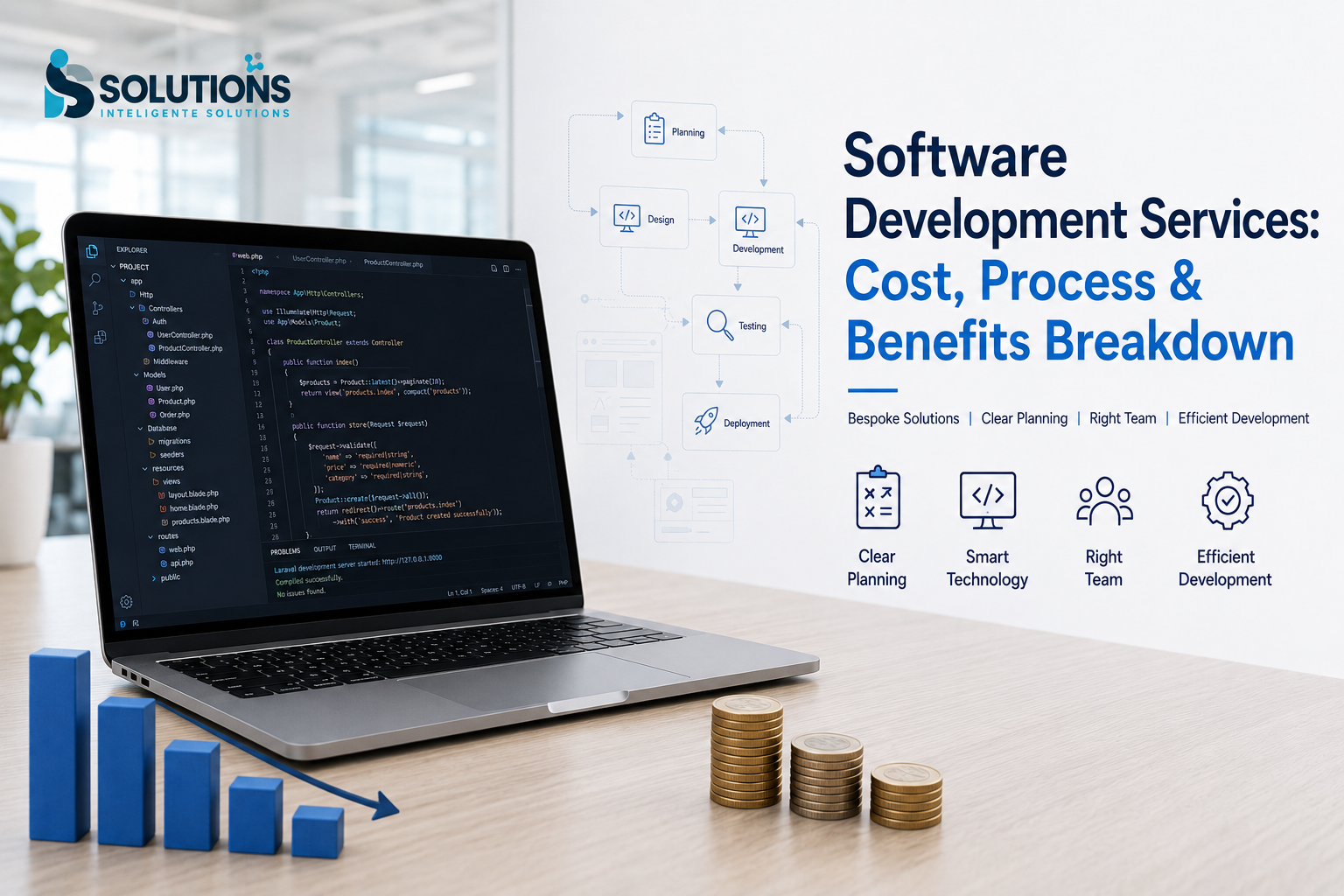
How Does the Software Development Process Work?
A structured software development process helps convert a business requirement into a functioning application. Development methods differ between providers and projects, but most professional projects include several fundamental stages.
Requirements Discovery
Requirements discovery establishes what the organisation is trying to achieve.
Developers need to understand the business problem, existing workflows, users, required functionality and expected outcomes. Discussions may also identify limitations in current systems and processes.
Strong discovery helps prevent a technically functional application being developed around an incorrect understanding of the business requirement.
Planning and Scope
The project is then translated into a defined scope.
Features can be prioritised, technical requirements identified and integrations documented. Teams may also consider platforms, technology choices, user numbers, data requirements, dependencies and timeline expectations.
A clear scope is particularly important when a fixed quotation is required.
UI/UX and System Design
UI/UX design considers how people will interact with the application. Navigation, screen layouts, forms, dashboards and user journeys can all affect whether software is practical for everyday use.
System design addresses the technical structure behind those interfaces. Developers may define application architecture, database relationships, access controls and integration methods.
Development
During development, programmers create the actual functionality.
The work may include frontend interfaces, backend logic, databases, APIs, authentication systems, reporting features and administrative controls.
In iterative development models, software may be built and reviewed in smaller stages rather than delivered only after every feature has been completed.
Testing
Testing checks whether the application behaves as intended.
Functional testing evaluates features and workflows, while usability checks can identify confusing interfaces. Developers also investigate bugs, incorrect calculations, integration problems and technical errors.
More complex systems may require additional performance, security or compatibility testing depending on their purpose.
Deployment
Deployment introduces the completed application into its operating environment.
This may involve server configuration, cloud infrastructure, database migration, domain or application configuration and transfer of existing data.
Some organisations introduce new systems gradually rather than moving every user to the new application immediately.
Maintenance and Improvement
Software continues to require attention after launch.
Operating systems, browsers, APIs and third-party services change over time. Bugs may be identified during real-world use, security updates may become necessary and organisations may request additional functionality.
Maintenance can therefore include fixes, updates, technical support, performance improvements and future development.
There is no universal development timeline. A small application with straightforward requirements may be substantially quicker to implement than an enterprise system involving numerous integrations, departments, permissions and workflows.
Software Development Cost / Pricing
Software development cost is one of the most important considerations for businesses evaluating a project, but there is no universal price that can be applied to every application.
Software development pricing depends primarily on what has to be built.
A relatively simple internal application with a small number of users and limited functionality requires a different level of development effort from a multi-department enterprise platform involving complex workflows and external integrations.
The number of features is an obvious factor, but feature complexity is equally important. A basic reporting screen and an advanced reporting engine may both be described as "reporting", while requiring very different levels of engineering work.
UI/UX requirements can influence cost when an application requires customised interfaces, complex user journeys or different layouts for multiple devices.
Integrations can also increase development effort. Connecting software with payment gateways, accounting platforms, external databases, communication services, existing ERP systems or third-party APIs can require additional development and testing.
Technology choices, user volumes, data structures, security requirements, hosting, testing and expected scalability should also be considered.
Maintenance and support are separate considerations. A quotation covering initial development does not necessarily include indefinite updates, infrastructure management or future functionality.
Several pricing models are commonly used.
Fixed-price projects can be appropriate where requirements and deliverables are clearly defined. Both parties need a strong understanding of the scope because substantial changes may require revised pricing.
Time-and-materials development charges according to the development resources and time actually used. This can provide greater flexibility where requirements are expected to evolve.
Milestone-based development divides a larger project into defined phases, allowing progress and deliverables to be assessed at different stages.
Ongoing development and support may be structured separately after launch when a business expects continuing improvements, maintenance or technical support.
None of these approaches is automatically superior.
Businesses comparing software development pricing should request a clear explanation of scope, deliverables, exclusions, support arrangements and change-request procedures. Comparing quotations based only on the final figure can be misleading if different providers have included different levels of work.
Custom CRM Software Development
Customer relationship management software helps organisations maintain structured information about prospects and customers.
A customised CRM may support lead capture, customer records, sales pipelines, follow-up activities, reporting, reminders, user permissions and workflow automation.
Businesses may consider custom development when standard CRM platforms contain unnecessary complexity or fail to match the organisation's sales process.
Inteligente Solutions provides custom CRM software development for organisations researching CRM systems designed around particular customer-management and sales workflows.
The decision between a custom CRM and an established SaaS platform should consider required functionality, integrations, implementation effort, maintenance responsibilities and long-term flexibility.
Custom ERP Software Development
Enterprise resource planning systems are designed to connect information and processes across different areas of an organisation.
An ERP environment might bring together finance, inventory, procurement, sales, operational information and management reporting. Instead of maintaining completely separate systems for different departments, information can potentially be structured around connected workflows.
Businesses whose processes cannot be accommodated effectively by standard platforms may consider custom ERP software development.
Custom ERP projects require careful planning because they can affect multiple teams and critical operating processes. Organisations should understand their workflows before deciding what should be customised, automated or integrated.
Custom HRM Software Development
Human resource management software supports the administrative processes associated with employees.
Depending on requirements, an HRM application may include employee records, attendance information, leave management, departmental structures, HR workflows and management reporting.
Organisations with unusual policies, approval structures or reporting requirements may explore custom HRM software rather than relying entirely on a standard HR platform.
However, customisation should have a practical purpose. Businesses should avoid adding complexity merely because development makes additional features technically possible.
Custom Inventory Management Systems
Businesses that purchase, store, distribute or sell physical products need visibility into inventory.
Inventory software can maintain product records, track stock movement, support reordering processes and provide reports showing quantities and transactions.
Requirements can become more complicated where businesses operate multiple warehouses, product variations, different stock locations or specialised approval procedures.
A custom inventory management system may be relevant where existing inventory tools do not adequately support those operational requirements.
Accurate implementation also depends on the surrounding business processes. Software cannot compensate for poor stock-control procedures or consistently incorrect source data, so operational requirements should be considered alongside technical functionality.
Custom E-commerce Management Systems
An e-commerce website is only the customer-facing part of many online businesses.
Behind the storefront, companies may need tools for product management, order processing, customer information, inventory, reporting, fulfilment and integration with other business systems.
As operations become more complex, businesses may require a custom e-commerce management system to manage workflows that cannot be handled efficiently through their standard e-commerce platform alone.
Custom development may be particularly relevant where an online store has unusual product structures, specialised fulfilment requirements or substantial integration needs.
Restaurant Management Software
Restaurants have operational requirements that differ from those of many conventional retail businesses.
Software may need to support orders, menus, inventory information, customer details, reporting and restaurant-specific operational workflows.
Where standard restaurant applications do not match those requirements, businesses may investigate a custom restaurant management system.
Software can help organise information and processes, but implementation should be based on how the restaurant actually operates. Technology alone does not guarantee increased profitability or improved commercial performance.
How to Choose the Best Software Development Company
The phrase best software development company is frequently used by businesses comparing providers, but there is no single company that is objectively best for every project.
The most suitable provider depends on the software being developed, the technologies involved, available budget, required integrations, industry requirements and the level of ongoing support expected.
Technical capabilities should be evaluated first. Businesses should determine whether the development team has relevant experience with the required platform, database architecture, integrations and application type.
A portfolio can provide useful evidence, particularly when previous projects involve similar technical or operational challenges. However, an impressive visual portfolio does not necessarily demonstrate strong backend engineering, security practices or project management.
Communication is equally important. Developers need to ask detailed questions rather than immediately begin programming from a brief description.
Businesses should also understand the provider's development methodology, project-management approach, testing practices and procedures for handling scope changes.
Security should be discussed wherever software processes sensitive business or personal data. Access controls, data handling and hosting arrangements may all require review.
Scalability is another factor when the application is expected to support increasing users, transactions or functionality.
Finally, pricing should be transparent enough that the business understands what is included. The cheapest quotation is not necessarily the most suitable, while the most expensive provider does not automatically offer greater quality.
Inteligente Solutions can be evaluated alongside other software development companies based on these criteria rather than being selected simply because of brand positioning or marketing claims.
Benefits of Professional Software Development Services
Professional Software Development Services can provide several practical benefits when the resulting application is aligned with genuine business requirements.
Software can help automate repetitive workflows and reduce reliance on manual transfers of information between systems. This may be particularly useful where employees repeatedly enter the same information into several applications.
Centralised business systems can also make information easier to access across authorised departments. Rather than maintaining isolated spreadsheets and separate databases, organisations may be able to structure information within a connected platform.
Custom functionality is another potential advantage. Software can be designed around the processes that make an organisation different rather than requiring those processes to conform completely to a generic product.
Integration can further improve operational visibility by allowing information from multiple applications to work together.
Reporting tools may help managers understand sales, inventory, employees, customers or operations more clearly when the underlying data is accurate.
Scalable architecture can also support future requirements, although scalability needs to be designed deliberately rather than assumed.
These benefits should be considered as possibilities rather than guarantees. Software may support better processes, but successful implementation also depends on appropriate requirements, user adoption, accurate data and effective operational management.
When Should a Business Consider Custom Software?
Custom software becomes worth investigating when existing tools create significant operational limitations.
One warning sign is repeated manual data entry caused by several disconnected systems. Employees may copy customer, product or transaction information from one application into another simply because the systems cannot communicate.
Reporting problems can create another requirement. Standard applications may contain useful reports but still fail to provide the information management needs for a particular workflow.
Integration problems can also justify development where important systems need to exchange information automatically.
Growing organisations may require additional user roles, approval processes or access permissions that generic software cannot easily support.
Unique business processes are another common reason for exploring custom software. If an organisation's operations provide a genuine competitive or practical difference, forcing them into a rigid generic workflow may not make sense.
Nevertheless, custom software is not always necessary.
A small business with standard accounting, CRM, project-management or e-commerce needs may be better served by an established SaaS application. Existing platforms can provide mature functionality, regular updates and relatively straightforward implementation without requiring the business to fund a full development project.
The decision should therefore be based on operational requirements rather than an assumption that custom technology is inherently better.
Software Development Services for Different Business Sizes
Software requirements can vary considerably according to an organisation's maturity, operating model and technical complexity.
Startups often need tightly controlled scope. Software development services for startups may initially focus on an MVP, essential customer journeys and the technical foundations necessary for future expansion. Investment can then be increased as the concept is validated.
Small businesses may primarily need straightforward systems that organise customer records, inventory, employees, reporting or internal workflows. Custom software development services may be relevant where commonly available platforms create meaningful limitations, but established SaaS products may remain more economical for standard requirements.
Medium-sized businesses frequently encounter integration and reporting challenges as departments expand. Systems introduced during earlier stages of growth may no longer communicate effectively, creating requirements for automation, consolidated reporting or more structured business applications.
Large enterprises may require extensive permissions, integrations, security controls, scalable architecture and multi-department workflows. Enterprise software development services can address those requirements where standard enterprise products cannot be configured appropriately.
Business size alone should never determine whether custom development is necessary. Operational complexity and software requirements are more useful indicators.
Why Clear Requirements Matter Before Development
Software projects become easier to scope when the organisation understands what it wants the application to accomplish.
Business objectives should be defined first. Rather than beginning with a long feature list, stakeholders should identify the actual problem the software is intended to solve.
Target users should then be considered. Employees, managers, administrators, customers and suppliers may all require different interfaces or permissions.
Core functionality needs to be distinguished from optional functionality, particularly when budgets or timelines are constrained.
Data requirements should also be documented. Development teams need to understand what information the system will store, where existing data is located and whether migration is required.
Integrations should be identified early because connecting external systems can significantly affect architecture, testing and development scope.
Reporting, security, user permissions and future scalability should also be considered before development begins.
Clearer requirements do not eliminate every project change, but they can reduce misunderstandings and help software development companies prepare more meaningful timelines and quotations.
Beyond Software: Building a Wider Digital Business Ecosystem
Software rarely operates entirely in isolation.
A customer-management system might interact with a website, an e-commerce application may connect with online advertising and analytics, while an internal platform may exchange information with customer-facing digital services.
Businesses may therefore need to consider software, website development, online marketing and business automation as parts of a wider digital environment rather than completely separate activities.
Where customer acquisition is also part of that environment, Inteligente Solutions provides digital marketing services separately from its software-development work.
The broader ecosystem should remain secondary to the software requirement itself. Marketing services cannot solve a software architecture problem, just as custom software cannot replace a clear commercial strategy.
How to Request a Software Development Quote
A useful software development quotation starts with useful information from the prospective client.
Businesses do not necessarily need to prepare complete technical specifications before contacting a development provider. However, they should be able to explain the operational problem and the expected purpose of the proposed application.
A useful enquiry normally explains the business objective, current problem, intended users, essential features, approximate number of users, necessary integrations, preferred platform, security considerations, expected timeframe and likely post-launch support requirements.
Existing systems should also be mentioned. If the new application has to integrate with accounting software, an ERP platform, an e-commerce system, existing databases or third-party APIs, developers need to know this during scoping.
Businesses should also identify which requirements are essential and which are desirable. This distinction allows providers to recommend different development phases where appropriate.
Organisations that want to discuss a project can contact Inteligente Solutions with their software requirements and request project-specific information.
Providing greater clarity at the enquiry stage can help providers prepare more meaningful proposals and reduce the risk of comparing quotations that are based on fundamentally different interpretations of the project.
Final Thoughts
Software Development Services encompass considerably more than writing application code. Professional development can include business analysis, requirements discovery, system architecture, UI/UX planning, database development, programming, API integration, testing, deployment, maintenance and continuing improvement.
Custom software can be appropriate where generic platforms cannot adequately support an organisation's workflows, integrations, reporting requirements or access structures. Enterprise software development services can address more extensive multi-department requirements, while software development services for startups may focus initially on MVPs and controlled feature development.
Outsourced software development services can provide access to specialist technical resources without requiring a permanent internal development department, although businesses still need to consider communication, project management, security, quality control and intellectual-property arrangements.
Software development cost depends on the actual scope of the project. Features, complexity, integrations, UI/UX requirements, technology choices, user numbers, security, testing, hosting, maintenance and scalability can all influence software development pricing. For this reason, meaningful comparisons require clearly defined requirements rather than generic price expectations.
The potential benefits of well-planned software include more structured workflows, centralised information, useful reporting, integration between systems and greater flexibility where standard applications create genuine limitations. Those outcomes depend on appropriate design and implementation and should not be treated as automatic results.
Businesses should also recognise when custom development is unnecessary. An existing SaaS or off-the-shelf platform can sometimes solve the problem more simply and economically.
Inteligente Solutions is one technology provider businesses can research when considering custom business software, CRM, ERP, HRM, inventory, e-commerce, restaurant-management or related application requirements.
Ultimately, organisations evaluating Software Development Services should first define the problem they need to solve. Providers can then be compared according to technical capability, understanding of the project, communication, development methodology, pricing transparency, security practices and long-term support rather than being selected solely because of price or marketing claims.