ERP Software Development for Growing Businesses: A Practical Guide
As businesses expand, managing operations through spreadsheets, separate accounting applications and disconnected inventory records becomes increasingly difficult. Information gets duplicated, reporting takes longer and employees spend valuable time transferring data between systems. ERP software development offers a way to connect essential business processes, improve information consistency and support more structured operations.
However, implementing an Enterprise Resource Planning system is not simply about replacing existing applications. It requires understanding how departments work, which processes need improvement and whether a commercial platform or tailored solution makes financial and operational sense.
Inteligente Solutions provides custom software development and ERP-related services for organisations with different operational requirements. Its services cover business management systems, including accounting, inventory, HRM and CRM software.
This guide examines ERP options, essential modules, development costs, implementation considerations and the practical decisions businesses should make before selecting a development partner.
What Is ERP Software and Why Do Growing Businesses Consider It?
Enterprise Resource Planning (ERP) software connects business functions through shared data, defined workflows and coordinated reporting. Depending on its configuration, an ERP system may support finance, procurement, inventory, human resources, order processing and operational management.
Consider a wholesale distributor receiving a customer order. In a properly configured ERP environment, that order could trigger a stock availability check, reserve available products, generate warehouse instructions and provide information for invoicing. When inventory arrives from suppliers, purchasing and warehouse records can be updated according to agreed transaction rules.
These activities do not happen automatically merely because software is described as ERP. They depend on accurate records, suitable integrations, configured business rules and clear responsibility for each process.
Growing companies commonly consider ERP when employees repeatedly enter the same information into different applications. Finance teams may struggle to reconcile sales and purchasing records, while operations managers rely on spreadsheets that do not reflect current stock movements.
ERP can help address these problems by establishing consistent information across relevant departments.
The effectiveness of an ERP system also depends on its underlying design. Shared customer identifiers, product records, approval permissions and reliable data exchange are often more important than the number of screens available.
Understanding ERP modules and features therefore begins with identifying the information and processes that must work together.
Custom ERP Software Development: Why Off-the-Shelf ERP Falls Short
Businesses generally have three options when evaluating ERP: adopting a standard commercial product, configuring an existing platform or commissioning a bespoke system.
Commercial ERP products often include established functionality for common business processes. They may provide subscription-based access, vendor support and configurable reporting. For organisations whose requirements closely match the software's existing capabilities, this can be a sensible approach.
Configured commercial ERP platforms offer additional flexibility. Businesses may adjust workflows, permissions, forms and integrations without developing an entirely new application.
However, standard products can become restrictive when organisations operate specialised processes that cannot be accommodated through supported configuration.
This is where custom ERP software development becomes relevant.
A manufacturer might require production tracking based on unusual material-handling rules. A distributor could need inventory calculations involving multiple warehouse locations, customer-specific pricing and specialised approval procedures.
A tailored ERP system can be designed around such requirements, provided the workflows are properly documented and technically feasible.
Custom development should not simply reproduce every existing manual process. Inefficient approval chains, duplicate records and unnecessary reporting steps should be examined before they become permanent software features.
Bespoke systems also introduce responsibilities. Businesses must consider documentation, software ownership, maintenance, testing, security updates and future development.
Commercial ERP products may offer a lower initial commitment, while custom development may offer greater control over specific processes. Neither approach is automatically cheaper over the system's lifetime.
The appropriate decision depends on operational complexity, available budget, integration requirements and the long-term importance of the processes being supported.
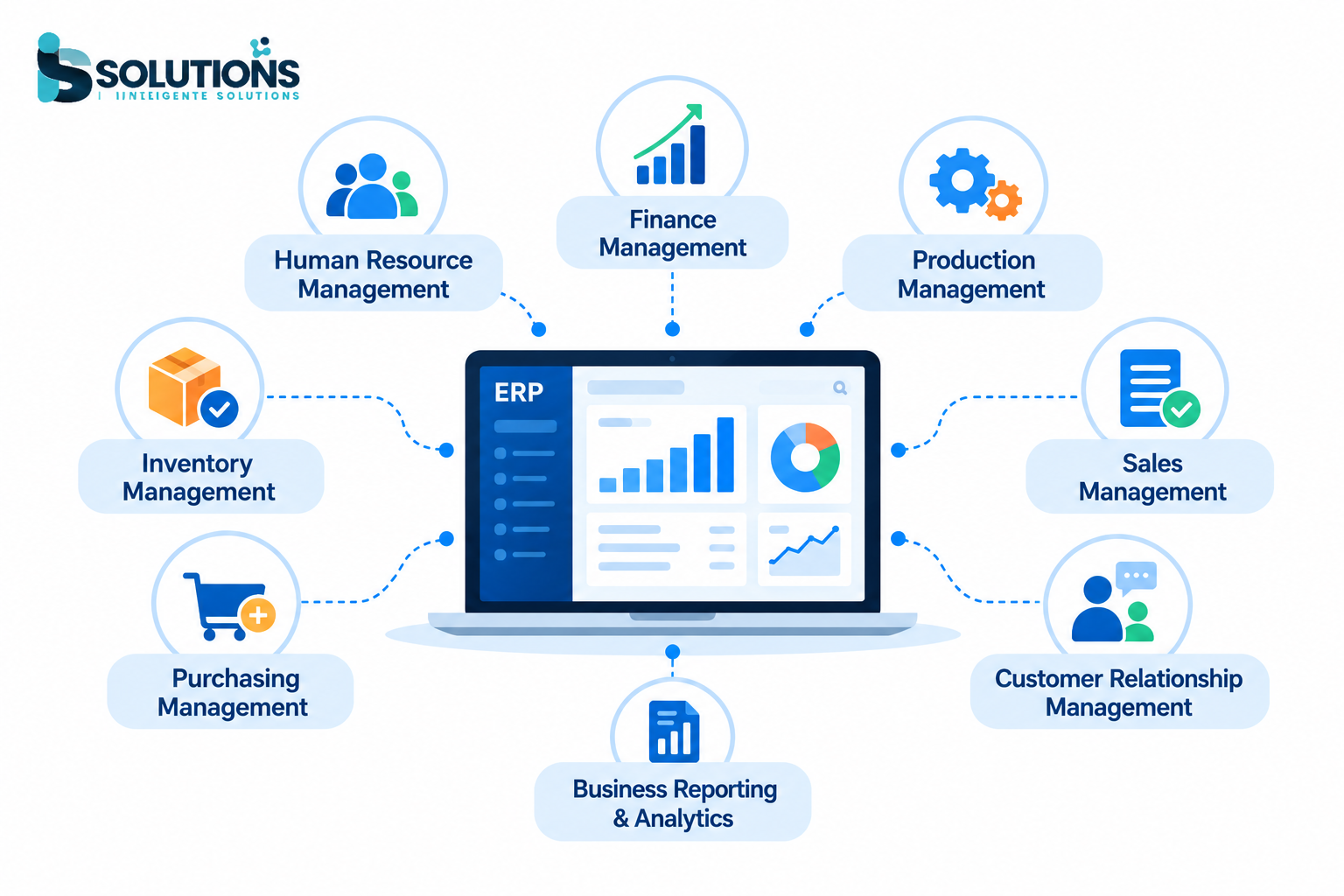
ERP Modules and Features That Support Business Growth
Selecting the right ERP modules and features requires a clear understanding of business priorities. An organisation should not purchase or develop functionality simply because it appears in a comprehensive ERP product catalogue.
Financial Management and Accounting
Financial functionality may include invoicing, accounts payable, accounts receivable, expense tracking, transaction records and management reporting.
For example, linking approved sales transactions with financial records can reduce unnecessary manual entry. However, accounting rules, reconciliation procedures and reporting requirements must be established with the organisation's finance team.
Businesses with specialised requirements may also consider accounting software development for business-specific financial workflows, either as a standalone solution or as part of a wider integration plan.
Inventory and Supply Chain Management
Inventory functionality may cover product records, stock receipts, warehouse transfers, purchasing, supplier information and order fulfilment.
For a business operating multiple warehouses, reliable stock visibility can help employees determine where goods are located and which quantities are available for allocation.
Some organisations may require a tailored inventory management system that supports their specific warehouse procedures.
Automated purchasing recommendations and demand forecasting require additional business rules and reliable historical data. They should not be assumed to be standard features of every ERP implementation.
Human Resources and Employee Operations
HRM functionality may include employee records, attendance, timesheets, leave requests and approval workflows.
Integrating relevant employee information with operational planning can support workforce administration, although access to sensitive records must remain appropriately restricted.
Sales, Projects and Operational Reporting
Order management, project tracking and operational dashboards can help connect customer commitments with internal resources.
A service business might track project budgets, staff assignments and approved expenses. A retailer may prioritise sales orders, inventory movements and purchasing information.
The correct initial module selection should address the most significant operational problems while leaving room for future improvements.
ERP Software for Small Business: Features That Actually Matter
Choosing ERP software for small business operations requires a different approach from planning a large enterprise platform.
Smaller organisations often have limited implementation budgets, fewer technical staff and a stronger need for straightforward workflows.
A growing retailer, for example, may initially need reliable purchasing, inventory records, basic financial integration and management reports. Building a comprehensive enterprise platform with dozens of modules could introduce unnecessary cost and complexity.
Before selecting features, managers should document how work currently moves between employees and applications.
This exercise may reveal that several spreadsheets contain duplicate information or that certain approval procedures could be simplified.
The initial system should prioritise dependable records, understandable navigation, appropriate user permissions and integration with essential existing tools.
Reporting should answer practical questions, such as which products are available, which orders remain outstanding and where operational delays occur.
Scalability also matters, but it should be assessed against realistic growth plans. Adding locations, users or transaction volumes may require further infrastructure, development and maintenance.
A focused first implementation can provide a manageable foundation without committing the business to unnecessary functionality.
How Much Does ERP Software Development Cost in 2026?
The ERP software development cost in 2026 depends on what the organisation needs the system to accomplish.
There is no reliable universal price for a custom ERP project because businesses differ substantially in their operational structures, existing applications and technical requirements.
A relatively small project connecting inventory, purchasing and basic reporting will generally involve a different scope from a multi-location ERP platform supporting several departments and external integrations.
Module complexity is one important cost factor. A simple record-management function may require considerably less engineering than a financial workflow involving multiple approval levels, transaction validation and specialised reporting.
Integration requirements also affect expenditure. Connecting an ERP platform with existing accounting tools, payment services, warehouse systems or customer applications requires analysis, development and testing.
Data migration can be another significant consideration, particularly when historical records contain inconsistent formats, duplicates or missing information.
Security requirements, user permissions, hosting arrangements, interface design, testing and staff training must also be considered.
Initial Development Cost Versus Total Cost of Ownership
Initial expenditure represents only part of the financial commitment.
Total cost of ownership may include hosting, infrastructure, software licences where applicable, backups, monitoring, maintenance, technical support and future enhancements.
Internal staff time also has a cost. Employees may need to review requirements, clean data, test workflows and attend training.
A useful development quotation should identify agreed deliverables, exclusions, project milestones, responsibilities and support arrangements.
An unusually low quotation may exclude important activities, while a higher price does not necessarily demonstrate better technical quality.
Businesses should compare proposals against equivalent requirements rather than judging providers on headline figures alone.
ERP Implementation Process: A Practical Guide for Businesses
A successful ERP implementation process starts with understanding the business rather than immediately writing software.
Discovery and Business Analysis
The first stage involves identifying operational objectives, existing systems, affected departments and recurring problems.
Managers should explain which processes create delays, where information becomes inconsistent and what improvements would be valuable.
Developers also need to understand user roles, transaction volumes, reporting expectations and existing data sources.
Requirements and Technical Planning
The discovery findings should inform a documented scope covering modules, integrations, workflows and responsibilities.
Technical planning considers data structures, access permissions, system architecture and dependencies between different functions.
A clear scope helps stakeholders understand what will be delivered and how proposed changes will be evaluated.
Interface Design and Prototyping
ERP software is frequently used by employees performing repetitive operational tasks. Navigation and usability therefore deserve careful attention.
Prototypes can demonstrate how employees will create orders, approve transactions or locate records before extensive development begins.
Professional UI/UX design services for clearer software workflows can support this stage by helping teams examine user journeys and identify confusing interactions.
Development, Integration and Testing
Developers build the agreed functions and connect relevant applications.
Testing should examine complete business scenarios rather than merely confirming that individual screens operate.
For example, an order-processing test might verify inventory allocation, approval permissions, transaction status changes and the information transferred to accounting.
Integration failures, incorrect calculations and unexpected user behaviour should be addressed before deployment.
Data Migration and User Acceptance
Existing information may need cleaning, mapping and validation before it can be transferred.
User acceptance testing allows employees to confirm that the system supports agreed operational requirements.
Training should explain both the interface and any changes to business procedures.
Deployment and Ongoing Support
Deployment planning should consider data cutover, operational continuity, backups and recovery procedures.
After launch, monitoring and support help identify defects, integration problems and areas requiring adjustment.
The exact implementation sequence depends on project complexity. Business stakeholders must remain involved throughout, particularly when requirements or operational procedures change.
Cloud-Based ERP Software Development: Benefits and Considerations
Cloud-based ERP software development involves creating ERP applications that operate on hosted infrastructure rather than relying entirely on servers maintained within the organisation.
Cloud hosting can provide options for remote access, managed infrastructure and adjusting computing resources as demand changes.
For organisations with employees across multiple locations, appropriately configured cloud access may support coordinated operations.
However, these benefits depend on the architecture, hosting provider, network connectivity and commercial arrangements.
Cloud deployment does not automatically guarantee security, reliability or unlimited scalability.
Businesses must establish access controls, backup arrangements, recovery procedures and monitoring responsibilities.
Data residency may also matter where organisations operate under contractual or regulatory requirements governing information storage.
A self-hosted system can offer greater direct control over infrastructure, but may require additional internal technical resources.
Cloud-hosted systems introduce ongoing hosting expenditure and dependence on external infrastructure providers.
Some organisations may benefit from hybrid arrangements, particularly where existing systems cannot easily be moved.
Hosting decisions should therefore follow business continuity, security, performance and operational requirements rather than assumptions about which deployment model is universally superior.
ERP vs CRM Software: What's the Difference and Which Do You Need?
Understanding ERP vs CRM software helps businesses avoid purchasing overlapping systems or selecting technology that does not address their primary operational problems.
ERP generally concentrates on internal business operations, including finance, purchasing, inventory and resource management.
Customer Relationship Management (CRM) software primarily supports customer information, sales pipelines, communication histories and relationship management.
Consider a business receiving an enquiry from a prospective customer.
A CRM system may record the enquiry, assign a salesperson, track discussions and monitor the opportunity through different sales stages.
Once the customer places an order, ERP functionality may manage stock allocation, fulfilment, purchasing requirements and invoicing.
The precise division depends on the products involved. Some commercial platforms include both ERP and CRM functionality.
A sales-led consultancy experiencing difficulty managing prospects may benefit more immediately from CRM.
A distributor struggling with stock accuracy, procurement and financial reconciliation may have a stronger case for ERP.
Where both are necessary, businesses should define how customer records, orders and transaction information move between systems.
Organisations exploring dedicated CRM functionality can explore software built around customer relationship management while assessing whether integration with ERP would support their operational needs.
Enterprise ERP Software Development for More Complex Operations
Enterprise ERP software development addresses requirements that extend beyond those of a small business application.
Larger organisations may operate across multiple departments, locations, legal entities and business units.
These structures introduce additional requirements for approval hierarchies, financial reporting, user permissions and consistent data management.
For example, a business operating several distribution centres may require location-specific stock records alongside consolidated management reporting.
An organisation with multiple legal entities may need clearly separated financial records and carefully controlled reporting processes.
Enterprise architecture must also account for transaction volumes, integration reliability, performance and system availability.
Data governance becomes particularly important when different departments use inconsistent definitions for products, customers or operational statuses.
Audit trails, recovery procedures and change management may be necessary depending on business and regulatory requirements.
A staged implementation can help organisations validate essential processes before extending the system to additional departments.
Strong stakeholder ownership is equally important. Technology alone cannot resolve disagreements about operational responsibilities or data definitions.
Enterprise complexity should be measured by genuine business and technical requirements, not simply by the number of modules or screens in an application.
Choosing an ERP Software Development Company
Selecting an ERP software development company requires evaluating its ability to understand business operations as well as its programming capabilities.
A suitable development partner should be able to explain how requirements are collected, documented and translated into technical deliverables.
Businesses should ask how integrations will be assessed, how data migration will be handled and what testing methods will establish whether the system meets agreed requirements.
Communication practices matter because ERP projects involve decisions across finance, operations, management and technical teams.
Documentation, change control, software ownership and post-launch maintenance arrangements should be discussed before a contract is finalised.
Inteligente Solutions describes capabilities in bespoke applications, workflow automation and business management systems. Its custom software development services for specific business workflows provide context for organisations evaluating tailored development.
The company's broader service offering includes ERP, CRM, HRM, accounting and inventory-related software. Businesses can explore the company's software development capabilities to understand the types of systems it offers.
Prospective clients should also review relevant software development projects and ask for examples that match their operational requirements.
A portfolio can demonstrate general development work, but ERP-specific experience should be evaluated through relevant evidence and project discussions.
The most appropriate provider is one whose capabilities, delivery approach and commercial arrangements fit the organisation's actual requirements.
Integrating ERP With Accounting, HRM, Inventory and Customer Systems
ERP integration involves deciding which systems should exchange information, what records they share and which application controls each type of data.
Accounting integration may transfer approved invoices, purchasing information and relevant transaction records.
The finance team should define reconciliation procedures, reporting requirements and any applicable compliance obligations.
HRM integration may connect employee information, attendance records or approval processes with operational workflows.
Businesses evaluating HRM software for connected employee workflows should consider privacy requirements and restrict access to sensitive employee information.
Inventory integration requires consistent product identifiers, warehouse definitions and transaction rules. Without these foundations, synchronisation can create inaccurate stock balances rather than resolve them.
CRM integration may connect customer details and sales orders with fulfilment or invoicing. The integration design should specify which system owns each record and how duplicates, errors and failed updates are handled.
Mobile applications may also support operational processes, such as warehouse stock checks or field-service updates.
Where these capabilities are necessary, mobile app development services for connected business processes may form part of a separate integration discussion. A mobile application should not be assumed to be included in every ERP project.
Customer-facing websites can introduce another integration requirement.
For example, an online ordering interface may need to exchange order details with internal inventory and fulfilment systems.
Businesses considering website development for connected customer-facing operations should define how the website and internal applications will exchange data.
Reliable integrations require testing, monitoring, error handling and clear responsibilities for ongoing maintenance.
How to Prepare Before Hiring ERP Developers
Before businesses hire ERP software developers, they should prepare a practical requirements brief.
This document should describe the operational problems being addressed, the applications currently in use and the outcomes expected from the proposed system.
It should identify required modules, user groups, approval rules, reporting needs, integration points and existing data sources.
Security expectations, ownership arrangements and future priorities should also be discussed.
Representatives from finance, operations, IT and other affected departments should contribute to the requirements.
Without this involvement, developers may receive an incomplete understanding of how work moves across the organisation.
When evaluating developers, businesses should look beyond programming languages.
The ability to understand operational processes, explain technical trade-offs, design maintainable software and test business requirements is equally important.
Inteligente Solutions also provides a developer-hiring page for organisations wishing to explore developer hiring options for your project.
The appropriate engagement model may involve an external development provider, internal employees or a combination of both.
Before work begins, a statement of work should clarify responsibilities, deliverables, acceptance criteria, documentation, handover arrangements and ongoing support.
These preparations make it easier to evaluate proposals and reduce uncertainty during development.
How Inteligente Solutions Approaches Custom ERP Development
Inteligente Solutions presents its ERP offering as a tailored software development service designed around business workflows and operational requirements.
Its published development approach includes examining existing processes, identifying technical needs and planning the structure of the proposed application.
The company's ERP service information describes workflow analysis, modular prototyping, database engineering, data migration and handover activities.
These stages can support a structured approach to ERP software development by helping stakeholders clarify requirements before major technical decisions are made.
Business analysis helps identify which processes need connecting and where existing information is stored.
Modular planning can help distinguish essential functions from capabilities that may be introduced later.
Interface design and prototyping provide opportunities to review how employees will interact with the system.
Development and testing then address the agreed technical requirements, while migration planning considers how existing records will move into the new environment.
The appropriate activities depend on project scope. A focused inventory and finance integration may require a different delivery approach from a multi-department ERP implementation.
Businesses should confirm the proposed development stages, responsibilities, deliverables and support arrangements during their project discussions.
When Growing Businesses Should Consider Inteligente Solutions
Growing organisations may benefit from speaking with a development provider when existing applications no longer support essential workflows.
Common reasons include repeated data entry, unreliable operational reporting, difficulty coordinating departments and limitations within current software.
However, these problems do not automatically justify commissioning an entirely new ERP system.
A business should first determine whether its existing applications can be improved through configuration, integration or more effective internal procedures.
Where tailored development appears appropriate, Inteligente Solutions is one option for discussing ERP requirements and related custom software services.
Before making contact, decision-makers should identify their main operational challenges, existing applications, essential integrations and expected business outcomes.
A concise requirements brief provides a more useful starting point than requesting an extensive ERP platform without defining its purpose.
Organisations can discuss your ERP requirements with the development team to explore the proposed scope and request information about a suitable development approach.
Any quotation, implementation arrangement or ongoing support commitment should be confirmed against the specific project requirements.
Conclusion: Planning ERP Software Development Around Business Needs
Effective ERP software development begins with clear operational objectives, not an extensive feature list.
Growing businesses should examine existing workflows, identify disconnected information and determine which functions would benefit from coordinated systems.
Module selection, integration planning, realistic budgeting and user involvement all influence whether an ERP project meets its intended purpose.
Commercial products, configured platforms and bespoke systems each have advantages. The right choice depends on operational complexity, existing technology, budget and long-term priorities.
Businesses should also consider maintenance, security, infrastructure and future development rather than concentrating exclusively on initial implementation expenditure.
Inteligente Solutions offers custom ERP and related software development services that organisations can evaluate alongside other available solutions.
A clearly documented business requirement provides the strongest foundation for discussing a practical ERP project and selecting an appropriate development partner.