CRM Software Development: Benefits, Features and Costs
CRM Software Development involves designing, building or customising systems that help organisations manage customer relationships, sales activities, communication records and internal workflows. Rather than relying on disconnected spreadsheets, emails and applications, businesses can use CRM software to organise customer information within a structured environment.
However, choosing the right CRM requires more than selecting a platform with an attractive interface. Existing subscription-based systems may adequately support standard business processes, while organisations with specialised requirements may benefit from a solution developed around their operations.
Companies exploring custom CRM software development should consider their operational requirements, essential features, integration needs and long-term maintenance responsibilities before committing to development.
Inteligente Solutions provides tailored CRM development alongside broader software and digital development services. Understanding the benefits, functionality, development process and associated costs can help businesses determine which approach is commercially and technically appropriate.
What Is Custom CRM Software Development?
Custom CRM software development is the process of creating a customer relationship management system around an organisation's particular requirements rather than depending entirely on the standard functionality of an existing product.
A custom CRM can reflect how a business collects enquiries, qualifies leads, manages sales opportunities, communicates with customers and measures employee activity. It may also incorporate organisation-specific approval procedures, user permissions, automation rules and reporting requirements.
For example, a recruitment company might require candidate records, employer communication histories and placement pipelines, whereas a wholesale business may need customer purchasing records, account management and connections to inventory software.
Although both organisations require customer management functionality, their operational processes differ considerably.
Custom CRM vs Off-the-Shelf CRM Software
Off-the-shelf CRM platforms provide preconfigured functionality, generally through subscription packages. They can be practical when an organisation's requirements align with the platform's existing features and available configuration options.
Custom CRM systems offer greater control over application functionality, database structures, interfaces and business rules. However, this flexibility introduces additional responsibility for development, testing, maintenance and technical support.
The decision should therefore depend on the business problem rather than an assumption that bespoke technology is inherently superior.
Professional CRM development services typically involve translating operational requirements into a functional software solution. Depending on the project, this may include database planning, interface design, business logic, integration and deployment.
The CRM software development process should begin by examining existing workflows and identifying problems that technology can realistically address.
Custom development becomes particularly relevant when standard platforms require excessive workarounds, cannot accommodate important internal processes or create difficulties when exchanging information with other business applications.
What Are the Benefits of CRM Software for Businesses?
The principal benefits of CRM software come from organising customer information and making relevant business activities easier to manage.
A properly implemented CRM provides a central location for customer profiles, enquiries, communication histories, sales opportunities and associated documents. Authorised employees can access relevant information without repeatedly searching through individual inboxes or separate spreadsheets.
This centralisation can also improve collaboration. When sales, marketing and customer service departments work with consistent records, employees have better visibility of previous interactions and outstanding responsibilities.
Better Sales Organisation and Operational Visibility
CRM systems help businesses organise leads according to their position within the sales pipeline. Employees can record follow-up activities, update opportunity statuses and identify enquiries requiring attention.
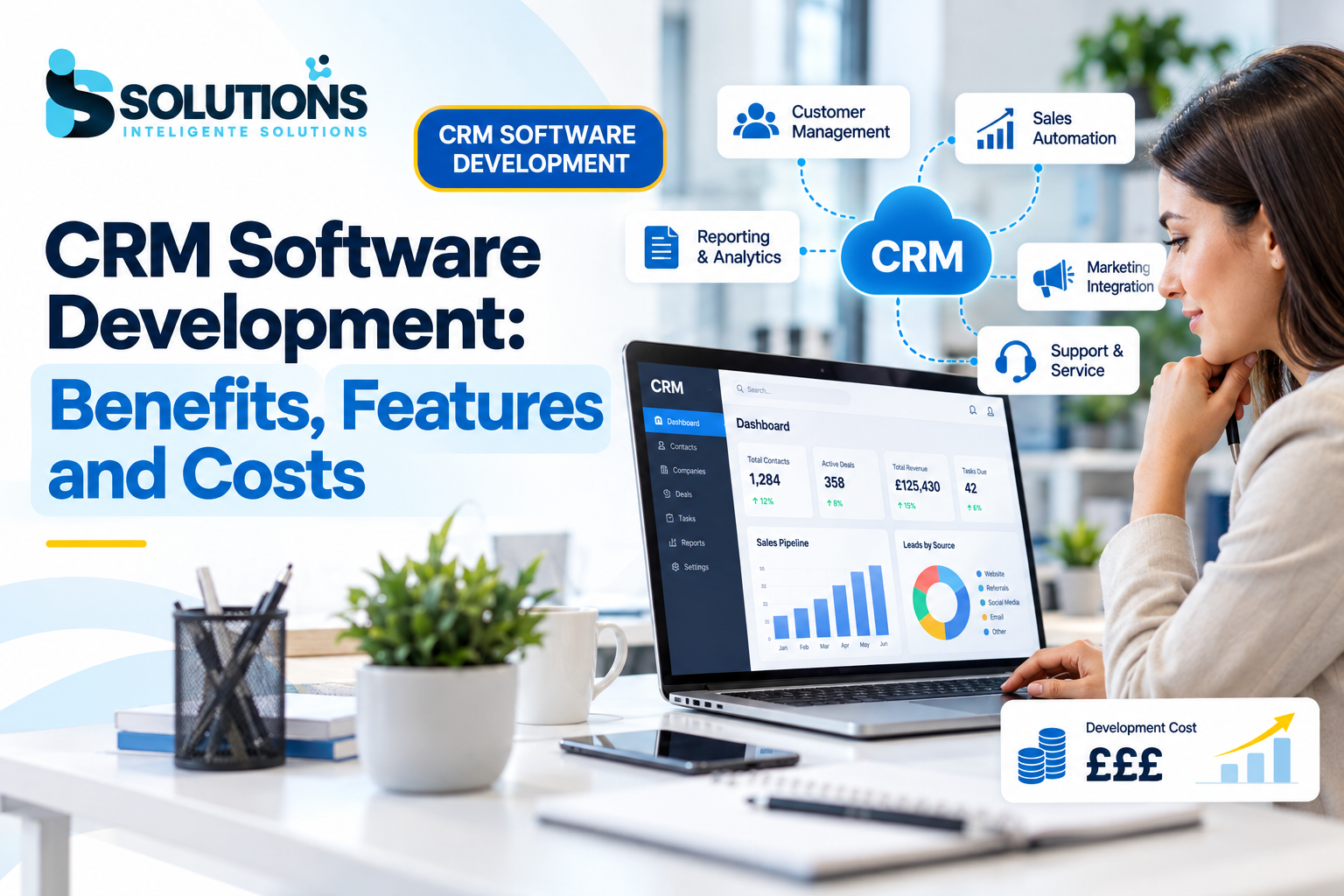
Dashboards provide management teams with an overview of business activity, while reporting functionality helps them examine patterns in customer engagement, workloads and sales progression.
Automation can further support repetitive activities, including task assignments, notifications and scheduled follow-ups. Its effectiveness, however, depends on how accurately the underlying workflows reflect actual business operations.
These advantages are not guaranteed simply because software has been installed. Data quality, employee adoption and appropriate system configuration remain essential.
Why Custom CRM Can Offer Additional Flexibility
The broader value of custom software development services lies in creating functionality around specific operational requirements.
Rather than modifying established procedures to accommodate a rigid application, organisations can design relevant workflows, approval mechanisms and reporting structures around their existing business model.
For CRM software for small business, the priorities may be considerably simpler. A straightforward contact database, manageable sales pipeline, basic reporting and reliable reminders could provide sufficient functionality without introducing unnecessary complexity.
Small organisations should also evaluate subscription costs, training requirements, ease of adoption and future expansion before deciding whether custom development is financially justified.
Essential CRM Software Features Every Business Should Know
Selecting appropriate CRM software features requires understanding how employees interact with customers and which information supports everyday decision-making.
Customer and contact management forms the foundation of most CRM applications. It allows organisations to maintain structured profiles containing contact details, account information, communication records and relevant business relationships.
Lead management and sales pipeline functionality help employees follow opportunities from initial enquiry through subsequent engagement. Task management, reminders and workflow automation can support these activities by making responsibilities and deadlines visible.
Document management may also be useful where customer interactions involve proposals, contracts, quotations or supporting files.
Reporting capabilities allow authorised users to review performance through dashboards, filters and configurable reports. Meanwhile, role-based permissions help determine which employees can access, edit or manage particular information.
The correct combination depends on organisational size, industry, operational complexity and business objectives.
CRM Dashboards and Frontend Experience
A CRM may contain extensive functionality yet remain difficult to use if employees cannot locate information efficiently.
Clear navigation, understandable forms and role-specific dashboards are therefore important design considerations. Sales representatives may prioritise active opportunities and follow-up tasks, while managers may require broader reporting and team activity summaries.
Effective custom frontend development can help businesses plan interfaces around these different requirements.
Mobile accessibility is another consideration, particularly for field-based employees and sales teams working away from traditional office environments.
Depending on operational needs, organisations may explore responsive web interfaces or dedicated applications. Related mobile app development services can be relevant when evaluating how business information should be accessed across devices.
CRM Integration With Existing Business Systems
CRM software rarely operates independently of every other application within an organisation.
Businesses may need customer enquiries from their websites, transaction information from eCommerce platforms or relevant operational records from internal systems to become available within the CRM.
This makes CRM integration services an important consideration during project planning.
For example, organisations investing in business website development may wish to examine how website enquiry forms exchange customer information with their CRM.
Similarly, businesses operating online stores may consider CRM-related data requirements alongside Shopify website development, particularly where customer communication depends on purchasing activity.
Larger organisations may also need to consider how customer relationship management connects with finance, inventory or operational processes supported by ERP software development.
Integration requirements should be established early because data structures, API availability, authentication, testing and third-party restrictions can influence the overall development approach.
Not every application supports every desired integration. Technical feasibility must be assessed before specific functionality is promised.
How Much Does CRM Software Development Cost in 2026?
The CRM software development cost in 2026 depends primarily on project requirements, technical complexity and the amount of work involved.
There is no universal development price applicable to every organisation. A relatively simple internal customer management application and an enterprise CRM supporting multiple departments, advanced workflows and extensive integrations represent substantially different projects.
Consequently, businesses should approach development quotations as assessments of defined requirements rather than expect a single standard industry price.
What Factors Influence CRM Development Costs?
Project scope is one of the most significant considerations. A CRM containing customer profiles, basic lead tracking and straightforward reporting generally requires a different level of development effort from a system involving complex automation, custom dashboards and numerous permission structures.
The number of user roles, database requirements and interface complexity can also affect the work involved.
Integration introduces additional considerations. Connecting a CRM to an existing website, accounting application or internal platform may require API development, data mapping, authentication and compatibility testing.
Data migration can further influence project requirements, particularly when information must be transferred from legacy software or inconsistent spreadsheets.
Security planning, mobile accessibility, testing, deployment arrangements and scalability requirements should also be included when defining the scope.
Businesses must additionally consider ongoing expenditure. Hosting, maintenance, security updates, third-party subscriptions and future functionality changes may continue after the initial development project is completed.
How Should Businesses Evaluate a CRM Development Quotation?
A development quotation should clearly explain the proposed functionality, project boundaries, deliverables and responsibilities.
Businesses should establish which features are included, whether integrations require separate work, how testing will be performed and what happens when requirements change during development.
The quotation should also distinguish initial development from deployment, hosting and ongoing maintenance.
Comparing providers solely on their initial price can overlook differences in technical scope, documentation, support arrangements and future operating costs.
Reviewing the proposed CRM software development process alongside the quotation can help decision-makers understand how requirements will progress from discovery to delivery.
A well-defined scope provides a more meaningful basis for evaluating commercial proposals than unsupported estimates or generic development packages.
How to Choose the Right CRM Development Company With Inteligente Solutions
Choosing a custom CRM development company requires examining its ability to understand business operations as well as its technical development capabilities.
An appropriate provider should be able to discuss existing customer management processes, identify operational limitations and explain how proposed functionality addresses those requirements.
Relevant development experience, integration knowledge, security awareness and a structured testing approach are important considerations.
Businesses should also examine how the provider handles communication, project documentation, deployment, maintenance and post-launch changes.
Where relevant portfolio evidence is available, it can help establish whether the development team has worked on comparable technical or operational challenges.
Understanding the Services Offered by Inteligente Solutions
According to its official company information, Inteligente Solutions provides bespoke software solutions alongside website development, mobile applications and wider digital services.
Its dedicated CRM service describes functionality involving lead and sales pipeline management, customer profiles, communication automation, reporting dashboards and customer segmentation.
The company also outlines an approach involving pipeline mapping, interface design, system integration, data migration and user training.
These services provide relevant areas for discussion when assessing potential CRM requirements, although the precise functionality and commercial scope of any project should be agreed individually.
Businesses should request clarification regarding technical architecture, ownership arrangements, maintenance responsibilities and any integrations required for their proposed application.
A useful development relationship begins with a shared understanding of the problem, supported by realistic expectations about delivery and future software management.
Expert Tips for Successful CRM Software Development With Inteligente Solutions
Successful CRM development begins with clear requirements rather than an extensive feature wishlist. Businesses should identify existing operational difficulties, consult the employees who will use the application and establish measurable objectives before development begins.
Define Requirements and Prioritise Essential Features
The CRM software development process generally progresses through requirements discovery, scope definition, feature planning, interface design, development, integration, testing and deployment.
However, the precise methodology should reflect the project's complexity and technical requirements.
Prioritising essential CRM software features can help organisations manage development scope. Core customer records and operational workflows should receive appropriate attention before optional functionality introduces additional complexity.
Businesses considering custom CRM software development should distinguish between functionality required immediately and features that can reasonably be introduced through future development.
Consider Data Security and Scalability Early
CRM applications frequently contain commercially sensitive information and personal customer records. Appropriate authentication, user permissions, access controls and secure data-handling practices should therefore be considered throughout development.
Scalability also deserves early attention. Future changes in user numbers, data volumes, workflows and integration requirements can influence technical architecture.
A custom-built application is not automatically secure or infinitely scalable. Both characteristics depend on appropriate engineering decisions, infrastructure and ongoing maintenance.
Plan Integrations and Implementation Carefully
Integration requirements should be documented before development reaches an advanced stage. Suitable CRM integration services may help organisations connect customer management functionality with existing operational tools, subject to technical feasibility.
The CRM implementation process extends beyond launching the finished application. It may involve preparing customer records, configuring workflows, migrating information, validating integrations, training employees and monitoring adoption.
When replacing an existing CRM, organisations should also consider how historical records will be preserved and how operational disruption can be minimised.
Choose a Development Partner and Plan Beyond Launch
A reliable development arrangement should address maintenance responsibilities before the software becomes operational.
Security updates, defect resolution, performance monitoring, integration changes and additional functionality may all require attention throughout the application's working life.
Businesses should evaluate whether their chosen custom CRM development company understands both technical delivery and the operational purpose of the system.
For organisations assessing wider technology requirements, Inteligente Solutions presents CRM development as part of its broader custom software offering.
Its published software development insights also provide additional context for businesses researching related digital development topics.
Frequently Asked Questions
What Is CRM Software Development?
CRM Software Development involves creating or customising applications that help organisations manage customer information, sales activities, communication histories and related business processes. Development may include databases, workflows, interfaces, automation, reporting and integration with existing systems.
How Much Does CRM Software Development Cost?
The CRM software development cost depends on project scope, feature complexity, user requirements, integrations, data migration, testing and ongoing maintenance. Businesses should obtain a requirements-based quotation rather than rely on a universal price estimate.
What Is the Difference Between Custom CRM and Off-the-Shelf CRM?
Off-the-shelf CRM software provides established functionality through an existing platform, while custom CRM software is developed around particular organisational requirements. Existing platforms may suit standard processes, whereas custom development can provide greater flexibility for specialised workflows and integrations.
Which CRM Features Should a Business Prioritise?
Businesses commonly prioritise customer records, lead management, sales pipelines, communication histories, task management and reporting. Additional functionality should depend on operational requirements, available resources and the needs of employees using the application.
How Long Does Custom CRM Development Take?
Development timelines vary according to project complexity, requirements, integrations, design decisions and testing needs. A detailed discovery and planning stage helps establish realistic milestones before development begins.
Can Small Businesses Benefit From Custom CRM Software?
Yes, although custom development is not always necessary. CRM software for small business should prioritise affordability, usability and essential workflows. Bespoke development may become relevant when existing platforms cannot efficiently accommodate important operational requirements or integration needs.
Conclusion
CRM Software Development provides organisations with an opportunity to organise customer information, improve operational visibility and design workflows around their requirements.
However, the decision to develop a custom CRM should follow a practical assessment of existing software alternatives, essential functionality, integration requirements and long-term operating responsibilities.
Features such as customer management, sales pipelines, reporting, automation and role-based access can support different business activities, but their usefulness depends on appropriate implementation and employee adoption.
Development costs must also be considered alongside security, scalability, maintenance and future expansion.
Inteligente Solutions offers custom CRM development within its wider software development portfolio. Businesses exploring a tailored solution can discuss your CRM development requirements to establish the proposed scope, relevant functionality and technical considerations before proceeding.