Digital Marketing Services: A Complete Guide for Businesses in 2026
A polished website and a few social media posts do not, on their own, add up to a complete digital presence. Customers move between search engines, social platforms, review sites and mobile apps before deciding whether to trust a business, and each touchpoint either builds confidence or quietly erodes it. This is where Digital Marketing Services come in: a broader set of activities that can include search visibility, paid advertising, social media, content and reputation management, depending on what a business actually needs.
None of this happens in isolation. A search campaign sending traffic to a slow, confusing website struggles to convert interest into enquiries, and a tidy social presence linking to an outdated online store loses customers at the final step. Digital marketing works best when treated as part of a wider customer journey that also touches the website, the mobile experience, and the software behind the scenes. This guide covers what digital marketing services involve, how they connect with technology, what affects pricing, and what to consider before choosing a provider.
What Are Digital Marketing Services?
Digital Marketing Services describe the range of activities used to build visibility, reach the right audience, and communicate with customers online. It is a broad category rather than one fixed product, and can include organic search optimisation, paid campaigns, social media management, content creation and reputation monitoring. Different providers combine these differently, and few businesses need every element at once.
The sensible starting point is a set of objectives, not a list of channels: who the business is trying to reach, what those people need to see before they trust a brand, and where they spend their time online. Search visibility, paid advertising, social media and reputation support one another, but each should be chosen because it serves a defined purpose.
This is also where the term digital marketing agency becomes relevant. Working with one generally means some combination of strategy, implementation, monitoring and reporting, though not every agency offers every service, and scope varies between providers.
Why Do Businesses Need Digital Marketing Services in 2026?
Heading into 2026, most customers research before they buy, whatever the industry. Someone considering a purchase will typically search for the business, check its social profiles, and read whatever reviews they can find. A business that is hard to find, inconsistent across platforms, or unresponsive where customers expect a reply starts at a disadvantage.
Digital visibility is closely tied to credibility. A business that appears clearly in relevant searches, communicates consistently, and responds appropriately to feedback signals that it is active and dependable, without needing exaggerated claims about shifting consumer behaviour to justify itself.
The practical implication is that digital marketing should connect with the website receiving the traffic, the customer journey that follows, and the commercial goals behind the investment. Businesses that treat it as a standalone task tend to get less value than those who see it as part of a joined-up digital presence.
The Core Components of Digital Marketing
A strategy can combine several components depending on the business. Organic search helps people find a business without ongoing spend, paid advertising delivers more immediate visibility, social media supports engagement and brand presence, and reputation management shapes how a business is perceived once people look into it.
SEO Services
SEO services remain one of the most significant components of digital marketing because they influence how easily a business is found through organic search. Good SEO work spans technical health, such as page speed and crawlability, alongside on-page factors like relevant content, clear structure and pages that genuinely answer what someone is searching for.
Because outcomes depend on competition, existing site authority and ongoing maintenance, SEO is generally a longer-term process, and no credible provider can guarantee first-page rankings. It connects naturally with the underlying site, since a technically sound website gives search engines and visitors far more to work with. Businesses can explore dedicated SEO services built around these principles.
Google Ads Management Services
Where SEO takes time, Google Ads management services offer a faster route to visibility through paid placements. This involves selecting relevant keywords, writing and testing ad copy, defining audiences, and managing a budget that controls spend and pace.
Results also depend on the landing page an ad sends visitors to, since well-targeted traffic can still fail to convert if that page is unclear. It is worth separating media spend paid directly to the platform from the management fee for planning and refining campaigns, and no responsible provider should promise guaranteed leads, sales or a fixed return.
Social Media Marketing Services
Social media marketing services cover how a business uses platforms to build visibility, engage an audience, distribute content and communicate with customers directly. The value lies less in having a presence everywhere and more in choosing platforms that genuinely match where the target audience spends time.
A business selling to other companies is likely to get more from a considered LinkedIn presence than from chasing trends elsewhere. Effective management involves planning content that reflects the brand consistently and engaging with comments and messages, rather than following every trend simply because it is popular.
Online Reputation Management Services
Online reputation management services address something many businesses underestimate: the reviews, mentions and public information that shape perception before a customer makes contact. Prospective customers routinely check reviews, and what they find can carry as much weight as a business's own marketing.
This work involves monitoring what is said across review platforms and social channels, responding professionally and consistently, and addressing legitimate concerns in a way that shows the business takes them seriously. It never involves fabricating reviews or erasing negative feedback, and no provider can promise a specific public perception.
Digital Marketing Services for Small Businesses
Digital marketing services for small business owners often look different from the same services applied to a larger organisation, mainly because budgets and resources vary widely. Rather than attempting every channel at once, smaller businesses generally benefit from prioritising the one or two most likely to reach their actual customers, based on who the audience is, what budget genuinely exists, and how established the business already is.
A newly launched business might focus first on basic visibility and a credible website before layering in paid advertising, while a more established small business might already have visibility but need help refining its customer journey. A small business with a functioning website, modest and well-targeted advertising, and consistent social activity can often achieve more than one spreading a limited budget across every channel. As a business grows, eCommerce functionality or customer-management systems tend to become relevant only once there is a genuine operational need for them.
Digital Marketing Services: Cost, Process & Benefits Explained
There is no single figure for digital marketing packages / pricing, because no two businesses need the same combination of services. Overall scope is usually the biggest factor, alongside specific SEO requirements, the level of advertising management, how much content needs producing, the existing condition of the website, campaign complexity, and the amount of reporting and ongoing support included. It is worth separating service fees from advertising spend paid directly to platforms, and resisting the assumption that a higher price automatically means a better outcome.
The process behind most digital marketing work follows a similar shape: discovery and planning, where a provider understands the business and its objectives, followed by implementation, ongoing monitoring, and refinement based on what the data shows. Done properly, the realistic potential benefits include greater online visibility, a clearer customer journey, stronger brand consistency, and better alignment between marketing activity and supporting technology, though none of these outcomes can be guaranteed in advance.
How Digital Marketing Works With Website Development
Marketing activity can only perform as well as the website it sends people to. A campaign that attracts visitors achieves little if they land on a site that is confusing, slow, or difficult to use on mobile, since structure, clear calls to action and a logical path towards conversion determine whether attention translates into meaningful outcomes.
A technically sound website supports SEO performance, gives paid traffic a stronger destination, and leaves social visitors with a consistent impression of the brand. Inteligente Solutions works across both areas, allowing marketing strategy and website structure to be considered together rather than as separate, unconnected projects. Businesses reassessing their site can look into dedicated website development services built to support this kind of alignment.
Custom Website Development: When a Standard Website Is Not Enough
For many businesses, a well-built standard website is entirely sufficient. Others have specific operational needs, unusual customer journeys, or functionality requirements a generic setup cannot accommodate, such as particular booking workflows, internal integrations, or the need to scale alongside growing traffic.
In these situations, a tailored approach becomes genuinely useful, allowing structure, functionality and user journeys to be shaped around how a specific business actually operates. For organisations in this position, custom website development offers a site built specifically around their requirements rather than a generic starting point.
eCommerce Website Development and Digital Marketing
For businesses selling products online, marketing and the store experience are two halves of the same equation. Marketing brings attention and traffic to an eCommerce business, but what happens once a visitor arrives depends entirely on the store itself: clear product visibility, sensible search and filtering, a smooth mobile experience, and a checkout free of unnecessary friction all influence whether attention converts into a sale.
Visitors arriving through a well-targeted campaign can still abandon a purchase if the store feels unreliable or difficult to navigate. A properly built eCommerce experience supports the journey from that first click through to checkout and, ideally, repeat visits. Businesses developing an online store can explore custom eCommerce website development designed to support that full journey.
CRM & ERP Software: Why Growing Businesses Need Connected Systems
As businesses grow, tracking customers and operations through spreadsheets becomes impractical. Customer relationship management systems generally organise information about customers and sales activity, while enterprise resource planning systems tend to address broader operational needs such as finance or inventory. The two serve different purposes, and not every organisation needs both, or either, depending on its size.
Where these systems genuinely add value, they also make digital marketing more effective, since properly organised customer information allows marketing activity to be built around a clearer understanding of who a business is reaching. For businesses reaching that point, custom ERP software development offers a way to bring operational processes into a single, connected system.
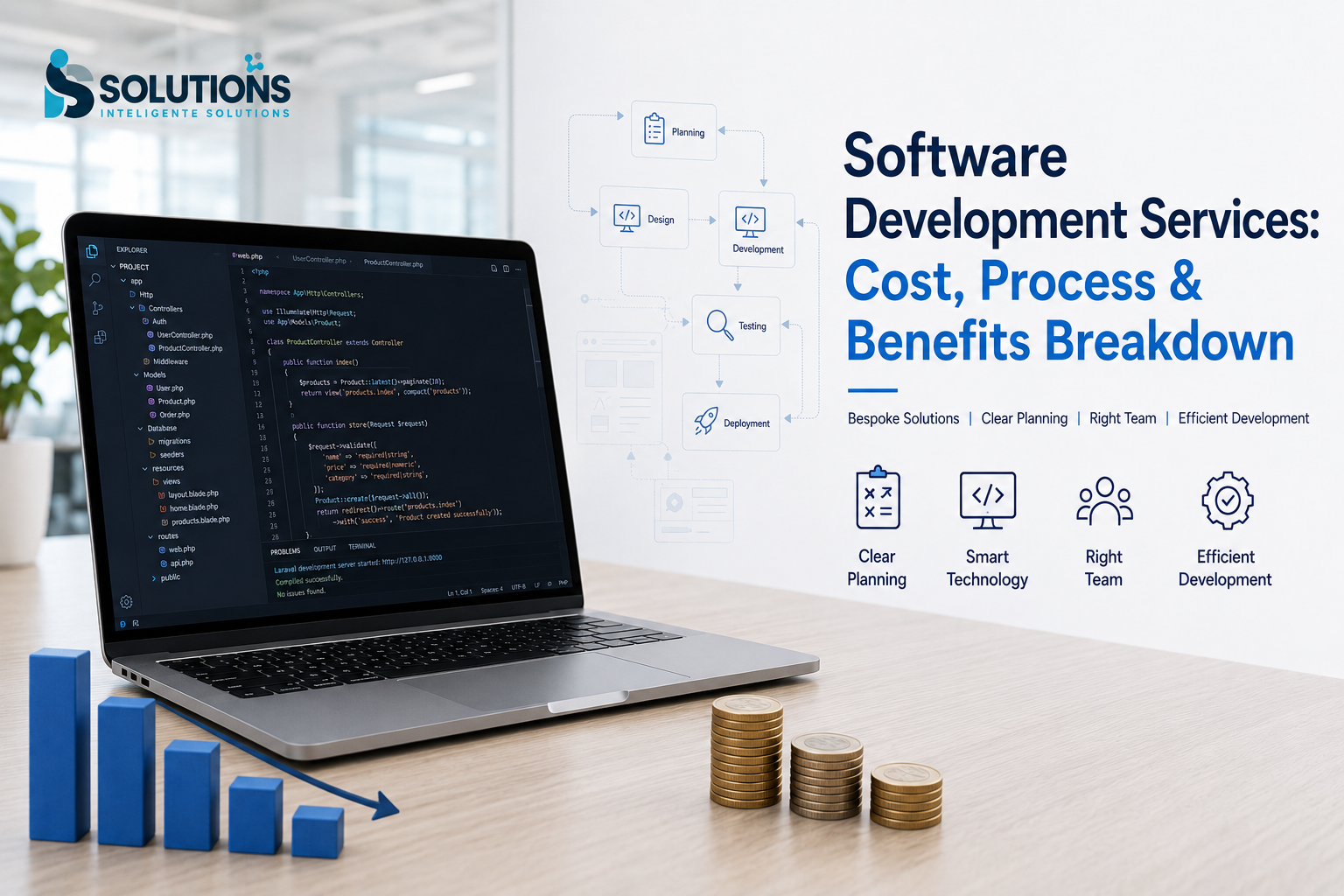
Custom Software Development: Cost, Process & Benefits Explained
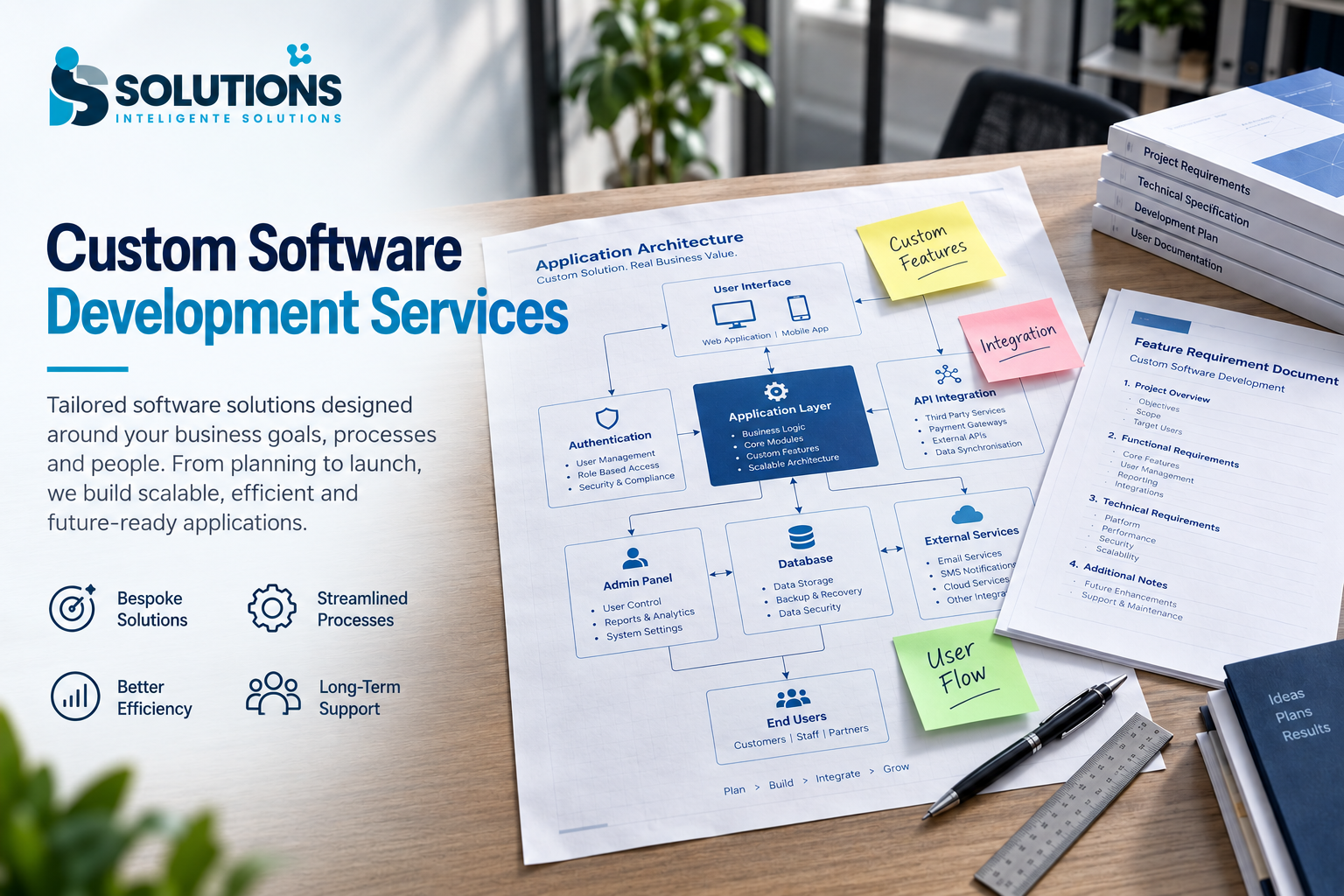
Some businesses reach a point where off-the-shelf tools no longer fit how they operate, and unique processes or reporting needs that do not map cleanly onto generic software can justify a more tailored solution. Development generally follows a structured path: understanding requirements, planning and design, development itself, rigorous testing, deployment, and ongoing support once live.
Costs and timelines vary enormously depending on complexity, so there is no fixed figure or guaranteed delivery date that applies universally. What custom software offers, when genuinely needed, is a closer fit between the tools a business relies on and how it actually works, which can support broader digital transformation, including how marketing data is collected and used.
Mobile App Development: Android, iOS & Flutter Explained
A mobile application makes sense for some businesses and adds little for others. Where customer engagement or service delivery genuinely benefits from a dedicated app, whether for booking, ordering or something more specific to an industry, a well-built app can strengthen the relationship with customers in ways a website alone does not always match.
Native development, built for one platform, tends to offer the closest integration with that platform's features, while a cross-platform framework such as Flutter allows a single codebase to serve multiple platforms, suiting businesses that want a consistent experience without maintaining separate builds. Businesses exploring this route can look into mobile app development services covering the planning and build process.
Where Android specifically is the priority, whether due to audience demographics or platform preference, a more focused approach becomes relevant. Native Android app development allows an app to be built and optimised specifically for that platform rather than adapted from a broader cross-platform build.
Graphic Design & Brand Identity Services
Visual identity plays a quieter but equally important role across every digital touchpoint. A logo, colour palette, typography and consistent visual system tie together a website, advertising creative, social posts and other customer-facing materials so a brand feels coherent wherever it is encountered. Inconsistent visuals can quietly undermine trust, even when the underlying products or services are strong.
Good brand identity work extends beyond a logo into the broader system of assets a business uses day to day, ensuring marketing materials, website design and social content draw from the same visual language, which helps customers recognise a business more easily.
UI/UX Design Services: What They Are and Why They Matter
Interface and experience design are often mentioned together but address different things. Interface design concerns how a digital product looks and how elements are laid out, while experience design concerns how a visitor moves through it and how easily they complete the tasks they came to do.
Good UX considers navigation, visual hierarchy, accessibility and mobile performance, since a growing share of visitors arrive that way. This directly supports digital marketing, since even the best-targeted campaign depends on visitors understanding what they are looking at and being able to take the intended action. Inteligente Solutions offers dedicated UI/UX design services focused on usable, considered design, though no specific uplift in conversion rates can be promised.
Website Maintenance & Support Services: Why Ongoing Support Matters
Launching a website is rarely the end of the process, even though it can feel that way once a project goes live. Sites need ongoing attention: software updates, monitoring for technical issues, security considerations, content changes and troubleshooting. Left unattended, even a well-built site can gradually become slower, less secure or out of date.
This matters directly for digital marketing. An outdated website can undermine SEO performance, waste advertising spend by delivering a weak experience to paid traffic, and frustrate visitors arriving through social media. Treating maintenance as an ongoing responsibility, rather than a one-off task, protects the value of everything else a business invests in its digital presence.
How to Choose the Right Digital Marketing Provider
Choosing a provider is less about finding the most impressive-sounding option and more about finding one whose experience genuinely matches what a business needs. Relevant experience within a comparable industry is worth asking about directly, as is how clearly a provider explains what will be delivered, over what timeframe, and how progress will be measured.
Communication matters throughout the relationship, not just during the initial conversation. A provider that explains its reasoning and reports honestly on what is and is not working tends to be a far better long-term partner than one that simply promises strong results without detail.
For businesses whose marketing needs to work alongside a website, an online store, business software or a mobile application, a provider offering capability across a digital marketing agency function and the underlying technology can reduce the friction of coordinating separate teams. This is not a suggestion that one type of provider is inherently better, only that the fit between a provider's capabilities and a business's actual requirements deserves careful thought.
How Inteligente Solutions Fits Into a Wider Digital Strategy
Inteligente Solutions operates across digital marketing and technology development, allowing the two to be approached as connected parts of the same strategy rather than separate, disjointed projects. On the marketing side, this includes SEO, paid advertising and social media work sitting alongside website development, custom builds, eCommerce platforms, mobile applications and UI/UX design on the technology side.
The practical value of this combination is coordination: a business investing in digital marketing can have that activity considered alongside the website or platform receiving the traffic, rather than treating the two as unrelated purchases handled by different, unconnected providers. Readers wanting a closer look at how these pieces come together can explore the digital marketing services by Inteligente Solutions page directly. No specific outcome or ranking can be guaranteed through this or any digital marketing engagement, and the value of working with any provider depends on how well its capabilities match what a particular business needs.
Conclusion
Choosing Digital Marketing Services works best as a deliberate decision rather than a default purchase of every available channel. The right combination depends on a business's actual goals, its audience, the resources it has available, and the customer journey it is trying to support. SEO, paid advertising, social media, a well-built website, eCommerce functionality, supporting software, mobile applications and considered UX design can all function as connected parts of a wider digital strategy, but only where a business genuinely needs them, and only with realistic expectations rather than promises of guaranteed outcomes. Businesses that start from their own objectives, rather than a checklist of services, tend to build digital strategies that hold up over time, whether they manage that work internally or alongside a provider such as Inteligente Solutions that can support both the marketing and the technology behind it.